
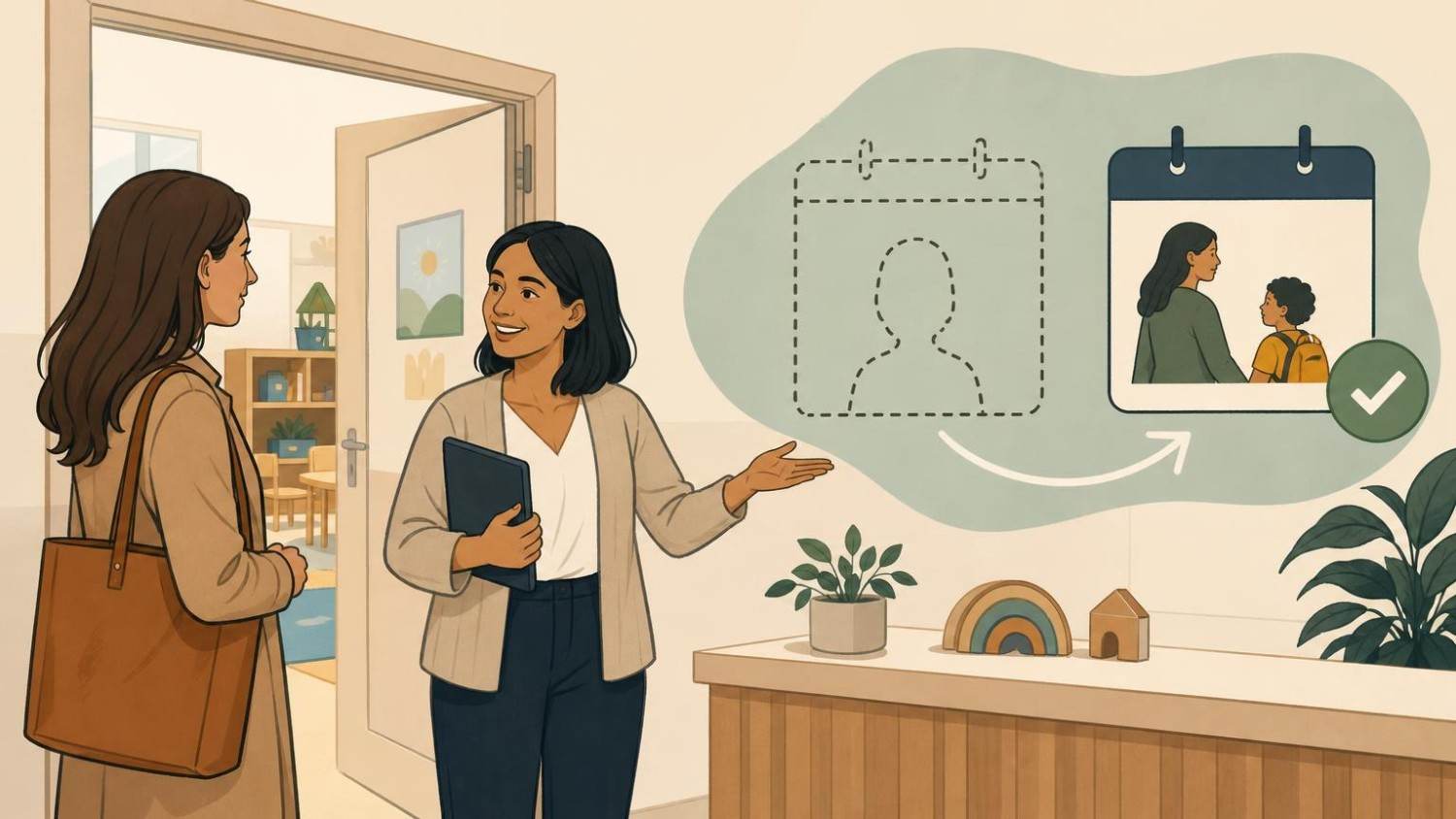
A parent books a tour of your childcare center. You block time on your director’s calendar, tidy up the classrooms, maybe even prepare a welcome folder. Then the parent simply doesn’t show up, no call, no text, nothing. If you run a childcare center, this scenario probably happens far more often than you’d like. Industry estimates suggest that tour no-show rates at childcare facilities can range anywhere from 20% to 40%, and every missed appointment costs your team time, energy, and potential enrollment revenue.
Reducing no-shows for childcare tours isn’t about chasing down reluctant parents: it’s about building a booking and communication system that makes showing up the path of least resistance. The strategies below are practical, tested, and designed for the way parents actually behave in 2026, not the way we wish they would.
The Impact of No-Shows on Childcare Operations
No-shows aren’t just annoying: they’re expensive. Think of each missed tour as a mini domino effect. Your center director blocked 30 to 45 minutes for a walkthrough and Q&A. A teacher may have prepped their classroom or adjusted an activity schedule. If you’re a smaller center, you might have even turned away another family from that same time slot.
The financial math is straightforward. If your average enrolled family generates $12,000 to $18,000 in annual tuition, and your tour-to-enrollment conversion rate sits around 50%, each no-show represents roughly $6,000 to $9,000 in lost potential revenue. Multiply that by five or ten no-shows per month, and you’re looking at a significant gap in your enrollment pipeline.
Beyond dollars, there’s a morale cost. Staff who repeatedly prepare for families that never arrive start to disengage from the tour process. That disengagement shows when a family does walk through the door: the enthusiasm feels a little thinner, the presentation a little less polished. No-shows erode the quality of the experience you provide to the families who actually show up.
The good news? Most no-shows aren’t malicious. Parents are busy, distracted, and often booking tours at multiple centers simultaneously. The centers that win are the ones that make their tour feel like the one appointment a parent can’t afford to miss.
Schedule a FREE 30 minutes Session with Us!
Optimizing the Initial Booking Process
The booking experience itself sets the tone. A clunky or impersonal scheduling process signals to parents that this tour is low-stakes and easy to skip. A smooth, intentional process does the opposite: it creates a small psychological commitment that makes no-showing feel like breaking a real promise.
Implementing Online Self-Scheduling Tools
Parents in 2026 expect to book things on their own time: 9 PM on a Tuesday while scrolling their phone, not during your office hours. If your booking process requires a phone call or an email exchange, you’re adding friction that both discourages bookings and weakens commitment. Tools like Calendly, HiMama’s scheduling features, or childcare-specific CRMs let parents pick a time slot that genuinely works for their schedule. That matters because one major reason people no-show is that they booked a time that was “close enough” rather than truly convenient.
Self-scheduling tools also let you control tour availability. You can limit slots to times when your best staff are present, avoid nap times or transition periods, and space tours so your team isn’t rushed. The result is a better experience for the families who do attend, which feeds back into higher conversion rates.
Qualifying Leads Before Confirming Appointments
Not every inquiry is a serious lead. Some parents are casually browsing. Others are comparing five centers and will ultimately choose the one closest to their commute. A short qualifying step during booking helps you focus your energy on families who are genuinely likely to enroll.
This doesn’t need to be aggressive. A simple booking form that asks the child’s age, desired start date, and how they heard about your center accomplishes two things. First, it gives you information to personalize the tour. Second, it creates a micro-commitment: the parent has invested a small amount of effort, which makes them psychologically more likely to follow through. Research on commitment and consistency bias, famously documented by psychologist Robert Cialdini, shows that even small acts of effort increase the likelihood of completing a related action.
Multi-Channel Communication Strategies
Booking the tour is step one. Keeping the parent engaged between booking and arrival is where most centers drop the ball. A single confirmation email sent three days before the tour isn’t enough. You need a communication rhythm that keeps your center top of mind without feeling pushy.
Automated Email and SMS Reminders
The minimum viable reminder sequence looks like this:
- An instant confirmation at booking (email and SMS) with the date, time, and a brief “here’s what to expect” note
- A reminder 48 hours before the tour, ideally via SMS since open rates for text messages hover around 98% compared to roughly 20% for email
- A day-of reminder two to three hours before the appointment
Each touchpoint should add value, not just repeat the date. The 48-hour reminder might include a quick testimonial from a current parent. The day-of message might mention something specific happening in the classroom that day. These small details make the tour feel real and worth attending.
One common mistake is relying exclusively on email. Parents’ inboxes are crowded. SMS cuts through in a way that email simply can’t, and most childcare CRMs in 2026 support automated text sequences out of the box.
The Power of a Personal Confirmation Call
Automation handles the heavy lifting, but a personal call from your director or enrollment coordinator within 24 hours of booking is the single most effective no-show prevention tactic I’ve seen. It doesn’t need to be long: 60 to 90 seconds is plenty.
The call serves multiple purposes. It puts a human voice and name to your center. It lets you confirm the appointment verbally, which creates a stronger social commitment than clicking “confirm” in an email. And it gives you a chance to ask if the parent has any specific questions or concerns, which helps you tailor the tour itself.
Centers that add a personal call to their confirmation sequence typically see no-show rates drop by 25% to 40%. That’s not a small improvement: for a center running ten tours a week, that could mean two or three additional families walking through the door each week.
Providing Clear Directions and Parking Information
This sounds almost too simple to mention, but unclear logistics are a surprisingly common reason parents bail on tours. A parent who can’t figure out where to park, which entrance to use, or how to find the office will sometimes just drive past and decide to reschedule later. Later rarely comes.
Include a short logistics section in your confirmation message: the street address with a Google Maps link, specific parking instructions (including whether visitor parking is available), which door to enter, and who will greet them. If your center is in a shared building or a tricky-to-find location, a 15-second video walkthrough from the parking lot to the front door can eliminate confusion entirely. Think of it as removing every possible excuse to turn around.
Building Pre-Tour Value and Excitement
Here’s what’s actually happening when a parent no-shows: your tour didn’t feel important enough to prioritize over the dozen other things competing for their time. The fix is to make the tour feel valuable before it even starts.
Sharing a Digital ‘Welcome Guide’ or Video Preview
Between booking and the tour date, send the parent something that gives them a taste of your center’s personality. A digital welcome guide works well: a short PDF or landing page that introduces your lead teachers by name and photo, shows a sample daily schedule, and explains your educational philosophy in plain language (not jargon-heavy mission statements).
Even better is a 60- to 90-second video from your director. Something casual and warm, filmed on a phone, that says: “Hi, we’re so excited to meet you and your daughter on Thursday. Here’s a quick peek at what our toddler room looks like during morning circle time.” This kind of personal preview creates an emotional connection before the parent ever steps inside. It transforms the tour from an abstract calendar item into a real appointment with real people.
Schedule a FREE 30 minutes Session with Us!
Highlighting Unique Program Features in Advance
If your center offers something distinctive, whether that’s a nature-based curriculum, bilingual instruction, or an unusually low teacher-to-child ratio, mention it before the tour. Don’t save your best selling points for the walkthrough. Tease them.
A pre-tour email that says “We can’t wait to show you our outdoor classroom, where our preschoolers spend about two hours every day regardless of weather” gives the parent a specific reason to show up. It shifts their mindset from “I should probably check out this daycare” to “I want to see that outdoor classroom.” Specificity creates curiosity, and curiosity drives attendance.
Managing Reschedules and Follow-Ups
Even with a great system, some parents will need to cancel or will simply forget. How you handle those situations determines whether you lose that family permanently or bring them back into your pipeline.
Creating a Frictionless Re-booking Experience
When a parent cancels or no-shows, your response in the first 30 minutes matters enormously. An immediate, friendly text that says “No worries at all! Would you like to pick a new time?” with a direct link to your scheduling tool keeps the door open without guilt-tripping.
The key is removing barriers. Don’t make them call during business hours. Don’t make them fill out the booking form again. One tap to reschedule. The easier you make it, the more likely they are to follow through the second time. Think of this like a checkout recovery email in e-commerce: the goal is to reduce friction to near zero.
Strategies for Re-engaging Past No-Shows
Parents who no-show and don’t immediately reschedule aren’t necessarily lost. They may have had a genuine emergency, or they may still be in the early stages of their childcare search. A structured follow-up sequence over the next two to four weeks can bring a meaningful percentage back.
A reasonable cadence looks like this:
- Day 1: Friendly reschedule text (as described above)
- Day 3: Email with your digital welcome guide or video, framed as “in case this is helpful while you’re exploring options”
- Day 10: A brief check-in asking if their childcare needs have changed
- Day 21: A final touchpoint, perhaps sharing a recent parent testimonial or news about your center
After four touches with no response, move the lead to a long-term nurture list rather than continuing active outreach. Persistence is good; pestering is not.
Analyzing Data to Improve Attendance Rates
If you’re not tracking your no-show rate, you can’t improve it. This is one area where even basic data collection pays enormous dividends. Start by measuring three numbers each month: total tours booked, total tours attended, and total enrollments from tours.
From there, look for patterns. Do no-shows spike on certain days of the week? Monday morning tours, for instance, tend to have higher no-show rates than midweek appointments because weekend plans bleed into Monday chaos. Are no-shows more common when tours are booked more than a week in advance versus two to three days out? Most centers find that shorter booking windows correlate with higher attendance, which might mean you should limit how far ahead parents can schedule.
Track which communication channels drive the best attendance. If parents who receive SMS reminders show up at 85% but email-only leads show up at 60%, that tells you exactly where to invest. Your childcare CRM should be able to generate these reports with minimal effort: platforms like ChildcareCRM, LineLeader, and HiMama all offer enrollment funnel analytics.
Review this data monthly. Small adjustments, like shifting your available tour times by an hour or adding one more SMS touchpoint, can move your attendance rate by five to ten percentage points. Over a year, that compounds into dozens of additional tours and, ultimately, more enrolled families.
Turning Tour Attendance Into a Competitive Advantage
The centers that consistently fill their enrollment spots aren’t necessarily the ones with the fanciest facilities or the lowest prices. They’re the ones that treat every tour as a high-value touchpoint and build systems to protect it. Reducing childcare tour no-shows comes down to a handful of principles: make booking easy, communicate with purpose and warmth, build excitement before the visit, and follow up without friction when plans change.
Start with the highest-impact change first. For most centers, that’s adding a personal confirmation call and an SMS reminder sequence. Those two steps alone can cut your no-show rate significantly within the first month. Then layer in the pre-tour content, the logistics details, and the data tracking over time. Each improvement compounds, much like interest in a savings account: small, consistent deposits that build into something substantial. Your future enrollment numbers will reflect the effort.

Share